Recent experimental advances allow trapped dilute Fermi gases of 6Li and 40K to be cooled far below the quantum-degeneracy temperature. Using a Feshbach resonance, experimentalists can tune the strength of the inter-particle interaction by adjusting a magnetic field. This allows experimentalists to realize tunable, strongly interacting, nonperturbative systems that bear strong similarity to nuclei and neutron matter and that exhibit a wide range of interesting physical phenomena, including the crossover from a Bose-Einstein condensate (BEC) regime to a Bardeen-Cooper-Schrieffer (BCS) regime. Of particular interest is the unitary regime, where the interaction is strongest (i.e., infinite scattering length). A pseudogap phase, in which the pairing gap is non-zero, was proposed to exist in the unitary gas above the superfluid critical temperature.
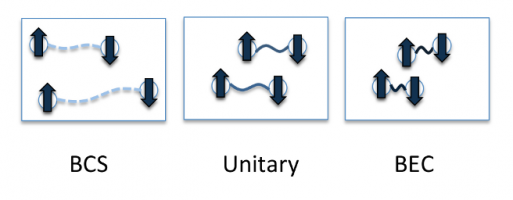
We are studying such cold atomic Fermi gases in the framework of the CI shell model, an approach widely used in atomic, molecular and nuclear physics.
The inter-particle interaction is usually modeled by a contact interaction. This interaction requires a regularization such as a cutoff in the number of oscillator shells in relative motion. The convergence of the many-particle energies in the regularization parameter is slow. We have introduced a new, separable effective interaction in the CI approach that allows for much faster convergence of the energies in the regularization parameter (PRL 2008, PRA 2012). This fast convergence has enabled us to calculate accurately spectra of few-atom systems.
We have introduced a new Monte Carlo method in the CI framework, CI Monte Carlo (CIMC), that uses a guiding wave function in Fock space to circumvent the sign problem and find an approximate solution to the ground state (PRA 2013). We have used the method to calculate the ground-state energy and energy-staggering pairing gap as a function of the number of particles for the trapped unitary gas.
We have applied the auxiliary-field quantum Monte Carlo (AFMC) method developed for nuclei to study the properties of a finite-size trapped cold atomic Fermi gas in the unitary limit of infinite scattering length (PRA 2013). Our calculations included the first ab initio determination of the heat capacity and energy-staggering pairing gap across the superfuid phase transition in any cold atomic system.
The homogenous two-component unitary Fermi gas has been studied extensively both theoretically and experimentally, and has connections to many areas of physics. A major topic of interest and debate is the existence and extent of a so-called pseudogap regime in which pairing correlations exist above the critical temperature for superfluidity. Previous quantum Monte Carlo simulations claimed to demonstrate a pronounced pseudogap effect. We have applied finite-temperature auxilliary-field quantum Monte Carlo (AFMC) methods to study the thermodynamics of the homogenous Fermi gas on a spatial lattice (PRL 2020). Our calculations differ from previous AFMC calculations in that we do not use a spherical cutoff in momentum space and carry out the calculations in the canonical ensemble of fixed particle number. We have calculated the heat capacity, condensate fraction, a model-independent pairing gap, and spin susceptibility. We find substantially reduced signatures of a pseudogap when compared with previously reported AMC calculations.
We made a major breakthrough (PRL 2020b) in the calculation of a fundamental property of quantum many-body systems with short-range interactions, known as the contact. The contact measures the likelihood of two atoms being close to each other and is important for understanding various properties of these systems. However, its calculation has been a major challenge for over a decade, with various theories yielding widely different results. Our results are in excellent agreement with recent precision experiments by two leading experimental groups, and provide the best quantitative agreement with these experimental results compared with all previous theoretical methods. An important step in our calculations was taking the continuum limit. This required AFMC calculations on large lattices, which were enabled by a novel algorithm we developed to reduce the complexity of the method (CPC 2021).
In arXiv:2408.16676, we extrapolated our lattice AFMC results to the continuous time and continuum limits for other thermodynamic observables, thus removing the systematic error associated with the finite filling factor of previous AFMC studies. Our results for the spin susceptilbility and pairing gap indicate that the pseudogap regime is narrow, with pseudogap signatures emerging at temperatures below 0.2 TF.
The physics of strongly interacting Fermi gases in two spatial dimensions (2D) differs signifiicantly from that of the 3D Fermi systems. While both the 2D and 3D systems undergo a superfluid transition below a critical temperature Tc, in 2D this phase transition does not have a non-vanishing condensate fraction with off-diagonal long-range order as in the 3D case, but instead exhibits a quasi-long-range order with algebraic decay of correlations in the super-fluid regime. This 2D superfluid transition is known as a Berezinskii-Kosterlitz-Thouless (BKT) transition.
We studied the 2D Fermi gas in its strongly interacting regime in the crossover from the Bose-Einstein Condensate (BEC) regime to the Bardeen-Cooper-Schrieffer (BCS) regime (PRL 2024, EPJ Special Topics 2025). This system provides a well-defined paradigm of strongly correlated
Fermi superfluids in 2D. Despite a decade of research, there have been no systematically controlled theoretical studies of the pseudogap regime of this system because of its strongly correlated nature. We carried out the first controlled calculation of two pseudogap signatures – the spin susceptibility and a free-energy pairing gap – using canonical-ensemble auxiliary-field Monte Carlo methods. Our results provide an important benchmark for upcoming experimental studies and other strong coupling theories.
Another interacting Fermi system we have been studying is the Fermi polaron, a paradiagmatic system in quantum many-body physics which describes a mobile impurity that interacts with a spin-polarized Fermi sea, first discussed by Landau. The Fermi polaron has been realized in cold atom experiments but has been challenging to address quantitatively in its strong-coupling regime. We carried out the first controlled thermodynamic calculations of the Fermi polaron in its strong coupling regime, using canonical-ensemble lattice AFMC methods (PRA 2025). As a spin-imbalanced system, the Fermi polaron has a Monte Carlo sign problem, but we showed that it is moderate over a wide range of temperatures and coupling strengths.
In particular we calculated the contact of the Fermi polaron as a function of temperature at unitarity and as a function of the coupling strength at fixed temperature (PRA 2025). We compare our results for the contact with recent experiments and find good agreement at unitarity (within error bars) but discrepancies away from unitarity on the BEC side of the crossover.
Recentlly, we introduced a novel method to calculate the impurity free energy of the polaron directly in AFMC. The impurity free energy is the difference between the free energies of the interacting and non-interacting systems. This quantity is of special interest because it relates two experimentally accessible spectral functions, the injection and ejection spectral functions.